
Update dtoa-benchmark to Rust 1.97.0
Pure Rust implementation of Ryū, an algorithm to quickly convert floating point numbers to decimal strings.
The PLDI'18 paper Ryū: fast float-to-string conversion by Ulf Adams includes a complete correctness proof of the algorithm. The paper is available under the creative commons CC-BY-SA license.
This Rust implementation is a line-by-line port of Ulf Adams' implementation in C, https://github.com/ulfjack/ryu.
[dependencies]
ryu = "1.0"
fn main() {
    let mut buffer = ryu::Buffer::new();
    let printed = buffer.format(1.234);
    assert_eq!(printed, "1.234");
}
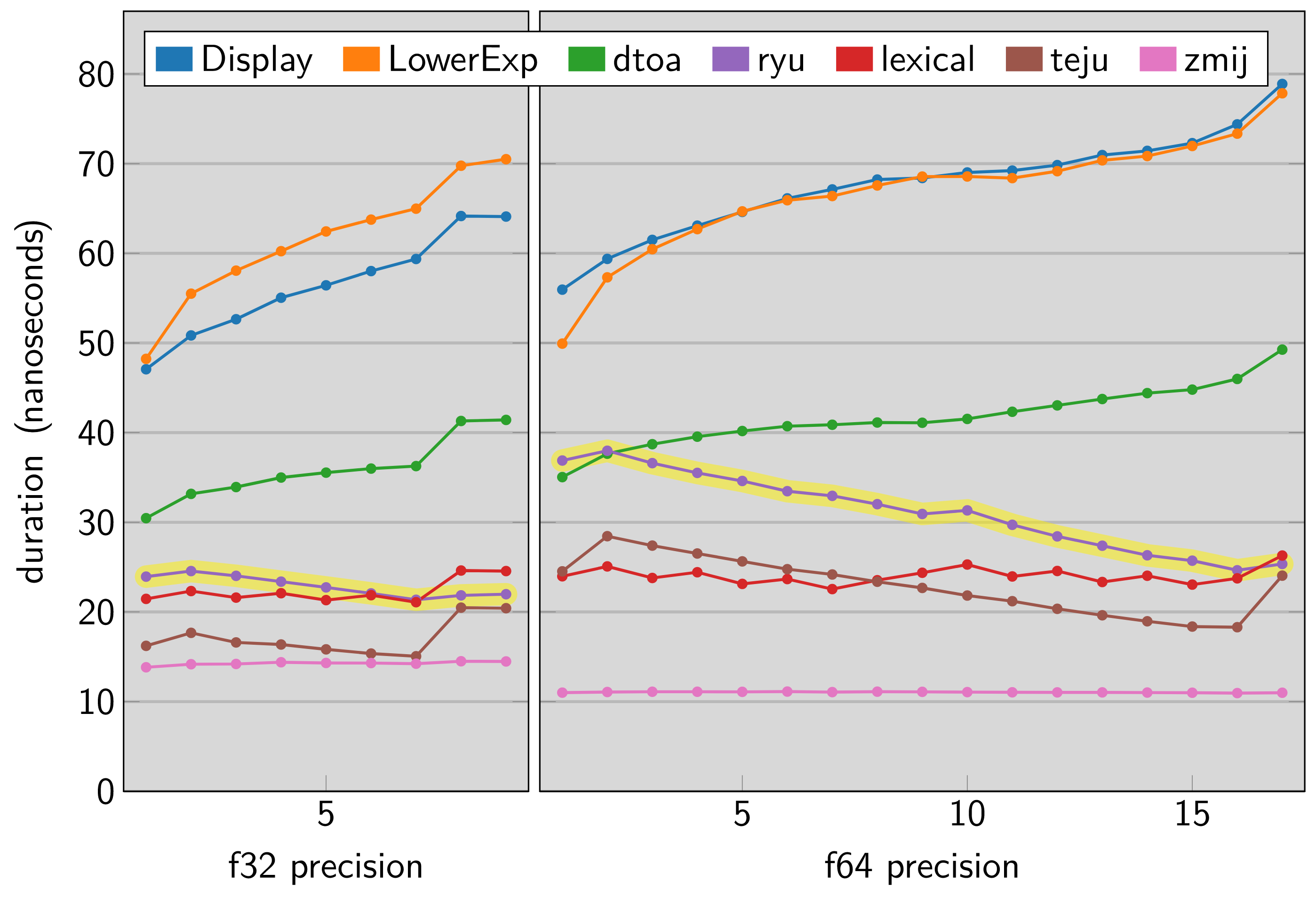
The dtoa-benchmark compares this library and other Rust floating point formatting implementations across a range of precisions. The vertical axis in this chart shows nanoseconds taken by a single execution of ryu::Buffer::new().format_finite(value) so a lower result indicates a faster library.
You can run upstream's benchmarks with:
$ git clone https://github.com/ulfjack/ryu c-ryu
$ cd c-ryu
$ bazel run -c opt //ryu/benchmark:ryu_benchmark
And the same benchmark against our implementation with:
$ git clone https://github.com/dtolnay/ryu rust-ryu
$ cd rust-ryu
$ cargo run --example upstream_benchmark --release
These benchmarks measure the average time to print a 32-bit float and average time to print a 64-bit float, where the inputs are distributed as uniform random bit patterns 32 and 64 bits wide.
The upstream C code, the unsafe direct Rust port, and the safe pretty Rust API all perform the same, taking around 21 nanoseconds to format a 32-bit float and 31 nanoseconds to format a 64-bit float.
There is also a Rust-specific benchmark comparing this implementation to the standard library which you can run with:
$ cargo bench
The benchmark shows Ryū approximately 2-5x faster than the standard library across a range of f32 and f64 inputs. Measurements are in nanoseconds per iteration; smaller is better.
This library tends to produce more human-readable output than the standard library's to_string, which never uses scientific notation. Here are two examples:
Both libraries print short decimals such as 0.0000123 without scientific notation.

